This post contains affiliate links
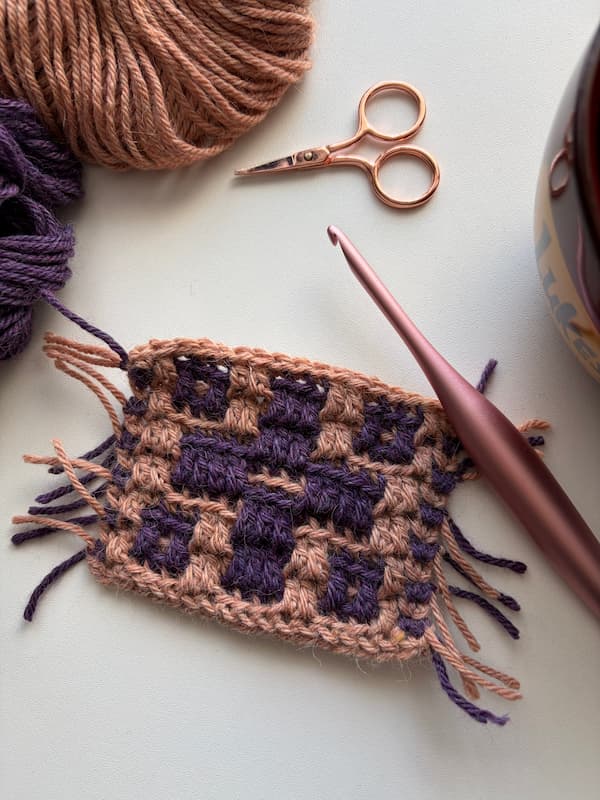
Overlay mosaic crochet is a colorwork technique where you work one color per row in single crochet through the back loop only, then drop mosaic double crochets into the front loops two rows below.
Those double crochets lie over the row behind them, building bold geometric patterns without ever carrying two colors at once.
That’s the textbook version. Here’s the real one: if you can single crochet and double crochet, you can do this. Seriously.
I’m using overlay mosaic in my brand new cardigan design (more on that very soon), so think of this post as your warm-up lap.
By the end, you’ll know how to read an overlay mosaic chart, what every symbol means, and you’ll have worked a little 17-stitch swatch from my free practice chart.
Let’s get stuck in.
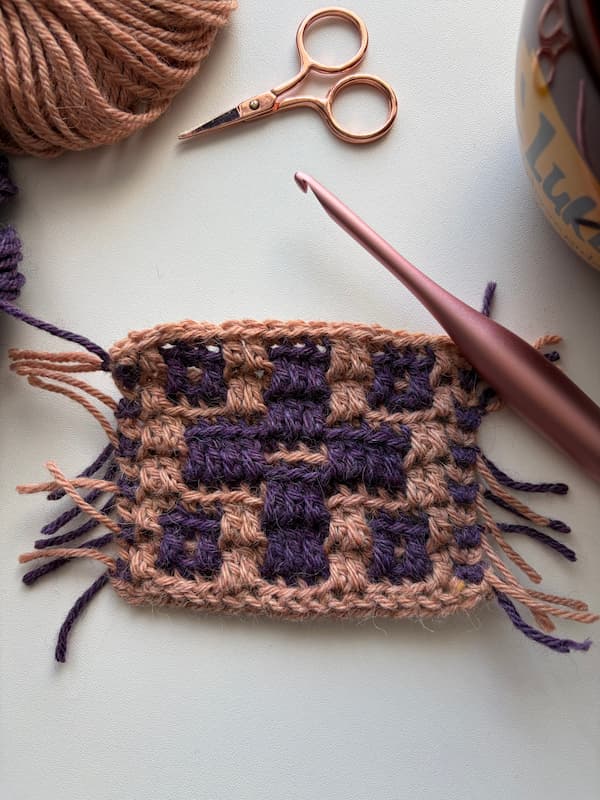
What is overlay mosaic crochet?
Overlay mosaic crochet uses just two stitches, sc in the back loop and a dropped dc, and one color per row to create a two-color picture.
Every row is worked in a single color, and you alternate colors every row: color A, color B, color A, and so on.
You never hold two yarns at once, which is why so many crocheters find it far less fiddly than tapestry crochet.
The magic happens when you work a mosaic double crochet.
Instead of going into the next stitch, it reaches down two rows to a stitch in the same color and covers up the different-colored row in between.
So a block of color A on the chart is really color A stitches from one row, reaching down over a color B row. Sneaky, right?
Overlay vs inset mosaic crochet: what’s the difference?
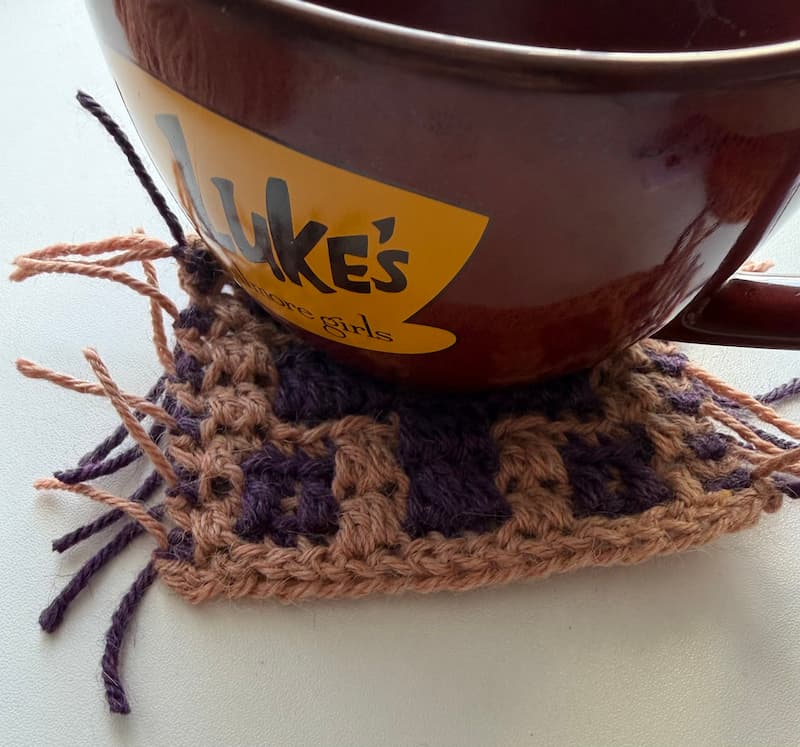
Overlay mosaic drops its double crochets in front of the previous row, while inset mosaic tucks them into chain spaces within the fabric.
| Overlay mosaic | Inset mosaic | |
|---|---|---|
| Base stitches | sc in back loop only | sc and ch-1 spaces |
| Where the dc goes | Front loop 2 rows below, laid over the row in between | Into the skipped stitch or chain space 2 rows below, sitting within the fabric |
| How rows are usually worked | Right side only, yarn cut at the end of each row | Usually back and forth, turning at the end of each row |
| Fabric | Thick, textured, raised dc on the front | Flatter, with color on both sides |
| Ends to manage | Lots, usually hidden in an envelope border or fringe | Far fewer |
| Charts | Square grid, X marks the mosaic dc | Similar grids, read slightly differently |
This post covers overlay mosaic only, because that’s the technique in my cardigan. Inset mosaic is a lovely technique too, but it deserves its own post.
Which stitches do you need for overlay mosaic crochet?
You need four stitches: foundation single crochet, single crochet in the back loop only, mosaic double crochet, and a border stitch at each edge.
That’s it. No secret stitch, no special hook, no crochet degree required.
Foundation single crochet (fsc)
This is Row 0 on the chart, worked in color A. It builds your starting chain and first row of single crochet in one go, so the bottom edge stretches as much as the rest of the fabric.
To work it: ch 2, insert hook in 2nd ch from hook, yo and pull up a loop, yo and pull through 1 loop (this makes the “chain” part), yo and pull through 2 loops (the sc part).
For every stitch after that, insert your hook under the 2 loops of the previous stitch’s “chain” and repeat. Make 17.
If fsc makes you twitch, a ch 18 followed by 17 sc does the same job.
Single crochet in the back loop only (sc blo)
This is every blank square on the chart. Work a normal sc, but only through the loop furthest away from you.
Here’s why it matters: the front loop you skip stays free. Two rows later, a mosaic double crochet will use it. No free front loop, no mosaic.
Mosaic double crochet (Mdc)
This is the X on the chart. Yo, insert your hook into the free front loop of the stitch two rows below, directly beneath where you’re working, and finish the dc as normal.
The dc stretches down in front of the previous row and covers it. Then skip the stitch behind your dc on the current row, because the dc takes its place. Your stitch count stays at 17.
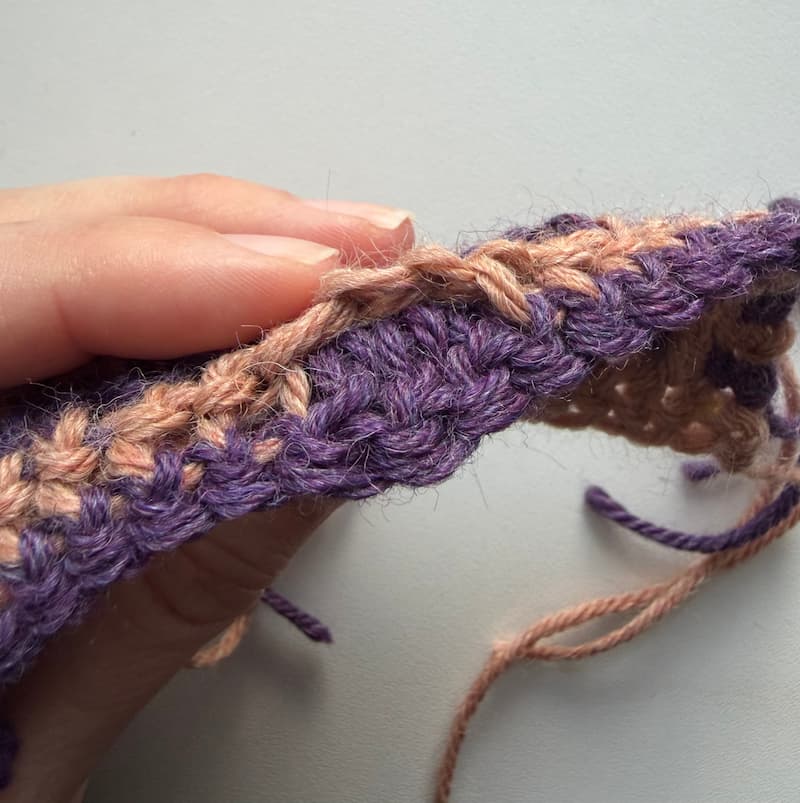
Border stitch (BS)
The first and last stitch of every row are border stitches. They frame the swatch and never take part in the pattern.
For this practice swatch, work each border stitch as a single crochet through both loops. That gives you a firm, tidy edge to anchor all those yarn tails.
How do you read an overlay mosaic crochet chart?
Read an overlay mosaic chart one row at a time from right to left, with the right side facing: blank squares are single crochet through back loop only (sc blo), X squares are mosaic double crochet (Mdc).
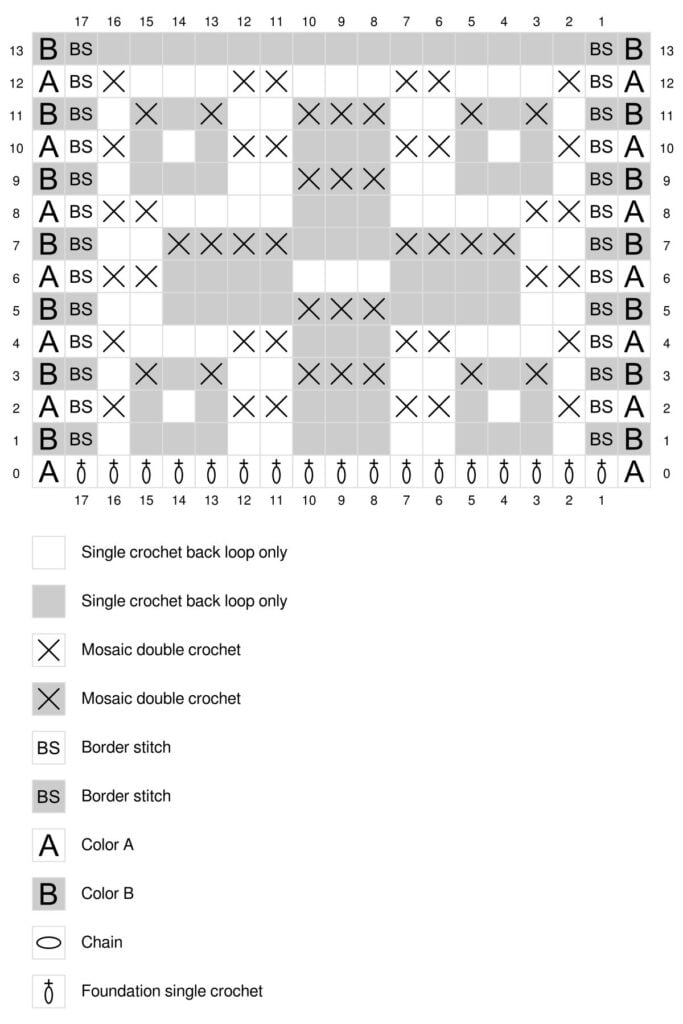
Here’s the free practice chart. It’s 17 stitches wide and 13 rows tall (plus the foundation row), in two colors.
- Each square is one stitch. Stitch 1 is on the right, stitch 17 on the left.
- Each row is one color. The letter at the end of the row tells you which: A (white) on even rows, B (gray) on odd rows.
- Always read right to left. You work every row with the right side facing, so you start at stitch 1 each time. Left-handed? Flip it and read left to right.
- Blank square = sc blo. X = Mdc. BS = border stitch.
- Fasten off at the end of every row. Leave a 4 to 6 inch tail, then join the next color in the first stitch on the right.
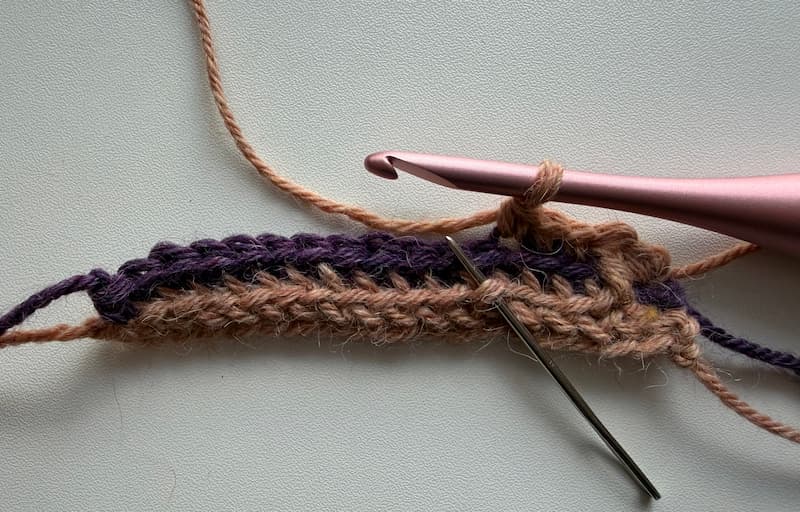
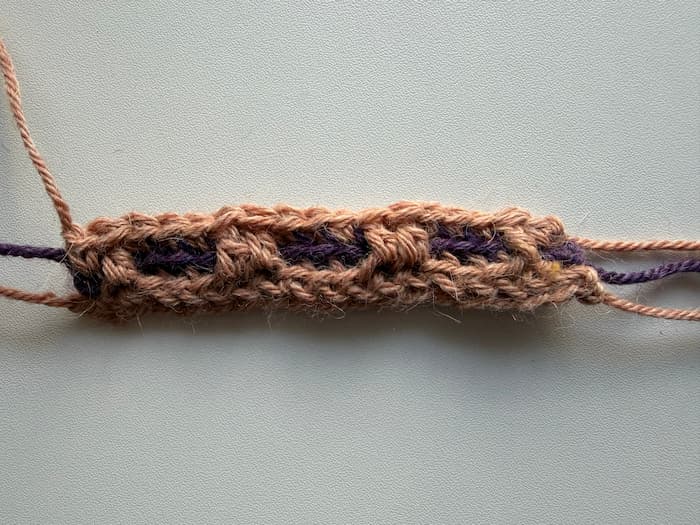
Why is there a gray square in a white row?
This is the bit that trips up almost everyone, so hear me out. The chart shows how the finished fabric looks, not which yarn you’re holding.
A gray square in a color A row means a color B mosaic dc from the row above will cover it. You still work that square in color A, exactly as the symbol says. That’s why the legend lists sc blo twice, once white and once gray: same stitch, different color showing.
>>> Follow the symbol, not the shading. <<<
One golden rule ties it all together: an X in one row covers the square directly below it in the previous row.
Free overlay mosaic crochet pattern: the practice swatch, row by row
This free practice swatch is 17 stitches by 13 rows, worked in two colors with the right side always facing, and it uses every stitch on the chart.
Grab two contrasting colors of the same yarn and the hook your yarn label recommends. Smooth, light-colored yarn makes those front loops much easier to spot.
Every row ends the same way: fasten off, leaving a 4 to 6 inch tail. Then join the next color in the first stitch on the right-hand edge.
Written Pattern
Row 0: Use color A, 17fsc
Row 1: Use color B, bs, 15sc blo, bs
Row 2: Use color A, bs, Mdc, 3sc blo, 2Mdc, 3sc blo, 2Mdc, 3sc blo, Mdc, bs
Row 3: Use color B, bs, 1sc blo, Mdc, 1sc blo, Mdc, 2sc blo, 3Mdc, 2sc blo, Mdc, 1sc blo, Mdc, 1sc blo, bs
Row 4: Use color A, bs, Mdc, 3sc blo, 2Mdc, 3sc blo, 2Mdc, 3sc blo, Mdc, bs
Row 5: Use color B, bs, 6sc blo, 3Mdc, 6sc blo, bs
Row 6: Use color A, bs, 2Mdc, 11sc blo, 2Mdc, bs
Row 7: Use color B, bs, 2sc blo, 4Mdc, 3sc blo, 4Mdc, 2sc blo, bs
Row 8: Use color A, bs, 2Mdc, 11sc blo, 2Mdc, bs
Row 9: Use color B, bs, 6sc blo, 3Mdc, 6sc blo, bs
Row 10: Use color A, bs, Mdc, 3sc blo, 2Mdc, 3sc blo, 2Mdc, 3sc blo, Mdc, bs
Row 11: Use color B, bs, 1sc blo, Mdc, 1sc blo, Mdc, 2sc blo, 3Mdc, 2sc blo, Mdc, 1sc blo, Mdc, 1sc blo, bs
Row 12: Use color A, bs, Mdc, 3sc blo, 2Mdc, 3sc blo, 2Mdc, 3sc blo, Mdc, bs
Row 13: Use color B, bs, 15sc blo, bs
Spotted the plot twist? Row 7 is the middle, and Rows 8 to 13 are Rows 1 to 6 in reverse. That’s a big clue about how mosaic designs are built, and it makes the second half fly by.
Count to 17 at the end of every row. If you’re a stitch out, the culprit is almost always a stitch you forgot to skip behind a mosaic dc.
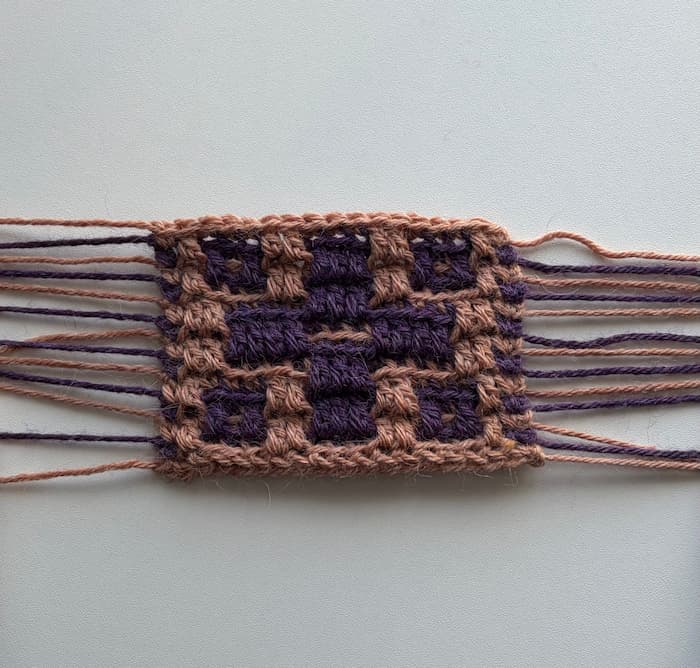
What do you do with all the yarn tails?
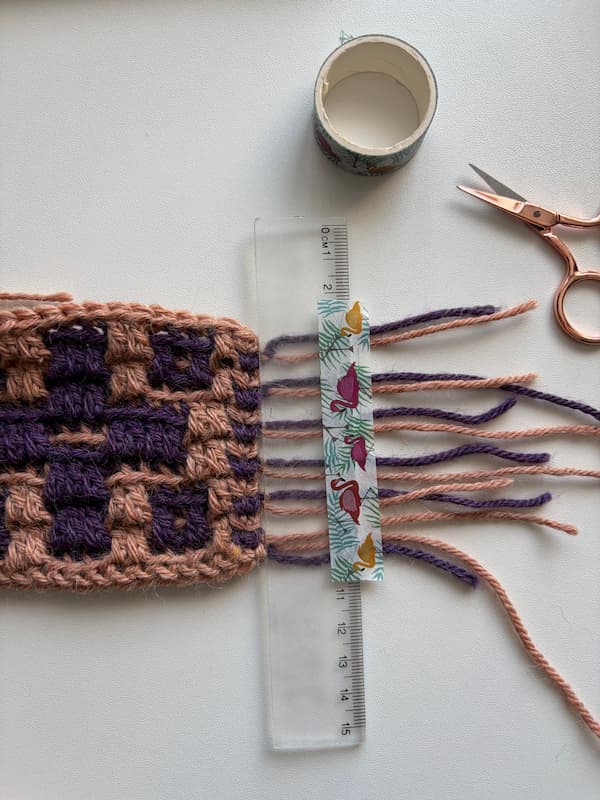
For a practice swatch, you can knot the tails in pairs or leave them as a fringe. In finished overlay mosaic pieces, the tails are usually hidden inside an envelope border worked along each edge.
Your pattern will tell you exactly how it handles them, so don’t weave in a hundred ends on a swatch unless you really love weaving in ends. (Nobody does.)
What are the most common overlay mosaic crochet mistakes?
Most overlay mosaic mistakes come from following the chart’s shading, forgetting to skip a stitch, or dropping the dc into the wrong row.
We’ve all been there. Here’s how to spot each one before it becomes a frogging session.
- Following the shading, not the symbol. You’ll end up working a mosaic dc where you needed a sc BLO. Blank square means sc BLO, every time.
- Forgetting to skip the stitch behind the mosaic dc. Your count creeps up to 18, 19, 20. Count every row.
- Dropping into the row directly below. The mosaic dc goes into the front loop two rows below, which is always the same color you’re holding.
- Working through both loops by habit. Then there’s no free front loop for the next mosaic row. Back loop only, except for the border stitches.
- Strangling your mosaic dc. If the dc is too tight, the fabric puckers. Let it relax so it lies flat over the row behind it.
Why does gauge matter more in overlay mosaic garments?
Overlay mosaic makes a thicker, denser fabric than plain single crochet, so your plain sc swatch won’t tell you the gauge of a mosaic garment.
All those dropped double crochets sit on top of the fabric. That changes how many stitches and rows you get per 4 inches, how much yarn you use, and how the fabric drapes.
Which brings me to my favorite soapbox: well-fitting crochet garments aren’t luck. They’re technique.
So when you make a mosaic garment, swatch in the mosaic pattern, make it bigger than 4 inches, block it, and measure in the center.
My How to Make and Measure a Gauge Swatch guide walks you through exactly that, from measuring stitch and row gauge to what to do when your numbers don’t match.
And before you start any sweater or cardigan, grab my free Pre-Sweater Checklist below. It helps you catch fit problems before you’ve spent 20 hours on something you won’t wear.
Overlay mosaic crochet FAQ
Is overlay mosaic crochet good for beginners?
Yes. If you can work single crochet and double crochet, you can learn overlay mosaic, because you only ever hold one color at a time.
Is overlay mosaic crochet reversible?
No. The pattern shows on the right side only, and the back shows mostly horizontal stripes of your two colors.
Why do you cut the yarn at the end of every row?
In overlay mosaic, every row is usually worked with the right side facing, so each row ends at the opposite edge from where the next one starts.
Can you work overlay mosaic crochet in the round?
Yes. The same rule applies: each mosaic dc goes into the free front loop two rounds below, in the color you’re holding.
What yarn is best for learning overlay mosaic crochet?
Use smooth, solid-colored yarn in two high-contrast shades. Fuzzy, dark or variegated yarn hides the front loops you need to find.
Can you make a crochet garment with overlay mosaic?
Yes. Swatch in the mosaic pattern first, because the fabric is thicker than plain crochet and changes your gauge, yarn use and drape.
What’s next?
Now you know how to read an overlay mosaic chart, work a mosaic double crochet, and finish a practice swatch. Make the swatch, count your stitches, and admire those crisp little blocks of color.
Then keep your hook warm, because this is exactly the technique in my new cardigan design.
Want to be first to know when it’s out? Join my email list and I’ll tell you the moment it’s ready.
Over and out! 🦩🧶
You might also like:
SHARE – If you think your crafty friends will like this, why not share the link with them? Alternatively, you can also share a direct link to this page on your social media so more people can crochet with us. Follow me on Facebook or Instagram and use #bluestarcrochet
PIN – do not forget to pin this page to your favorite Pinterest Board so you can easily find it later too.
JOIN – join like-minded crocheters working on my projects inside the Blue Star Crochet Facebook Community Group
SUBSCRIBE – It’s such an honour to share my crochet patterns with you and to be part of your creative journey. I’d love to stay connected and keep you inspired with new patterns, special discounts, and little surprises along the way. Sign up for my email newsletter & join a community of makers and enjoy a free gift as a thank-you for being here!

Veronika Cromwell | Blue Star Crochet
Veronika is a master in modern crochet design.
With a relentless focus on innovation and a vision that knows no bounds, she meticulously hones her crochet expertise she shares via crochet patterns, tutorials and online courses.
She helps the knowledge-thirsty crocheters bulldoze their way through hundreds of crochet techniques effortlessly and with ease like sharp scissors cutting thread.
Creating timeless fashion pieces without the “use-by-date” that stand the test of time in modern world is her lifelong mission.
Featured in Inside Crochet, Simply Crochet, Crochet Now and Happily Hooked and other awesome spaces on the internet, you too can join the crochet revolution!
Join her as she conquers the crochet world, one stitch at a time.


